

Is it safe for dogs to chew on sticks? Here's what you should know
Your dog spots a stick on the trail, snatches it up, and immediately looks like the happiest creature on earth. We get it. It's adorable. And it feels harmless.
But sticks are actually one of the most common causes of mouth and throat injuries in dogs — and most dog parents don't find out until something goes wrong. This isn't about being overprotective. It's about knowing what's actually happening when your dog chews that stick, so you can make the call that's right for them.
Why dogs love sticks so much
Before we talk about the risks, it helps to understand the appeal — because your dog isn't doing something random. They're doing something deeply instinctive.
Dogs are drawn to sticks for a lot of the same reasons they love chews: the texture, the resistance, the satisfying sensation of gnawing through something with a little give. For dogs who love to carry things, a stick also scratches that retrieval instinct. It's the right shape, the right weight, and it's everywhere.
The instinct behind stick chewing is completely healthy. The stick itself is the problem.
What makes backyard and trail sticks risky
They splinter — and the splinters are sharp
This is the big one. Most common sticks — think pine, birch, oak, or whatever's fallen in your yard — are dry, brittle woods that fracture under pressure. When a dog chews them, they don't fray or soften. They crack into sharp, jagged shards.
Those shards can cut the inside of your dog's mouth, get lodged in their gums or throat, or — in more serious cases — puncture the digestive tract if swallowed. Injuries from stick splinters are a genuinely common reason dogs end up at the vet.
You don't know what's on them
A stick from the backyard or a hiking trail has been outside, exposed to whatever's in that environment. That can include:
- Pesticides and herbicides — especially in yards, parks, or anywhere landscaped
- Mold and fungus — particularly on damp or decomposing wood
- Parasites and bacteria — soil-borne and otherwise
- Toxic plants — some trees and shrubs produce wood that's harmful to dogs, including black walnut, black locust, yew, and others
The wood itself might look fine. That doesn't mean it is.
The shape creates a puncture risk
This one is less obvious but worth knowing. If a dog is carrying or catching a stick and trips, falls, or collides with something, a stick held in the mouth can act like a spear. Oral and throat punctures from sticks happen more often than most people realize — and they can be serious.
"But my dog has chewed sticks forever and been fine"
We hear this a lot, and we understand it. Most of the time, nothing happens. Dogs are resilient and have been chewing sticks forever.
But "been fine so far" isn't quite the same as "it's safe." The risks are real, they're documented, and they tend to be the kind of thing that happens suddenly after a hundred uneventful stick sessions. It's similar to the reasoning behind any other low-probability but high-consequence risk — the fact that it hasn't happened yet doesn't mean it won't.
You know your dog best. We just want you to have the full picture.
What to give a stick-loving dog instead
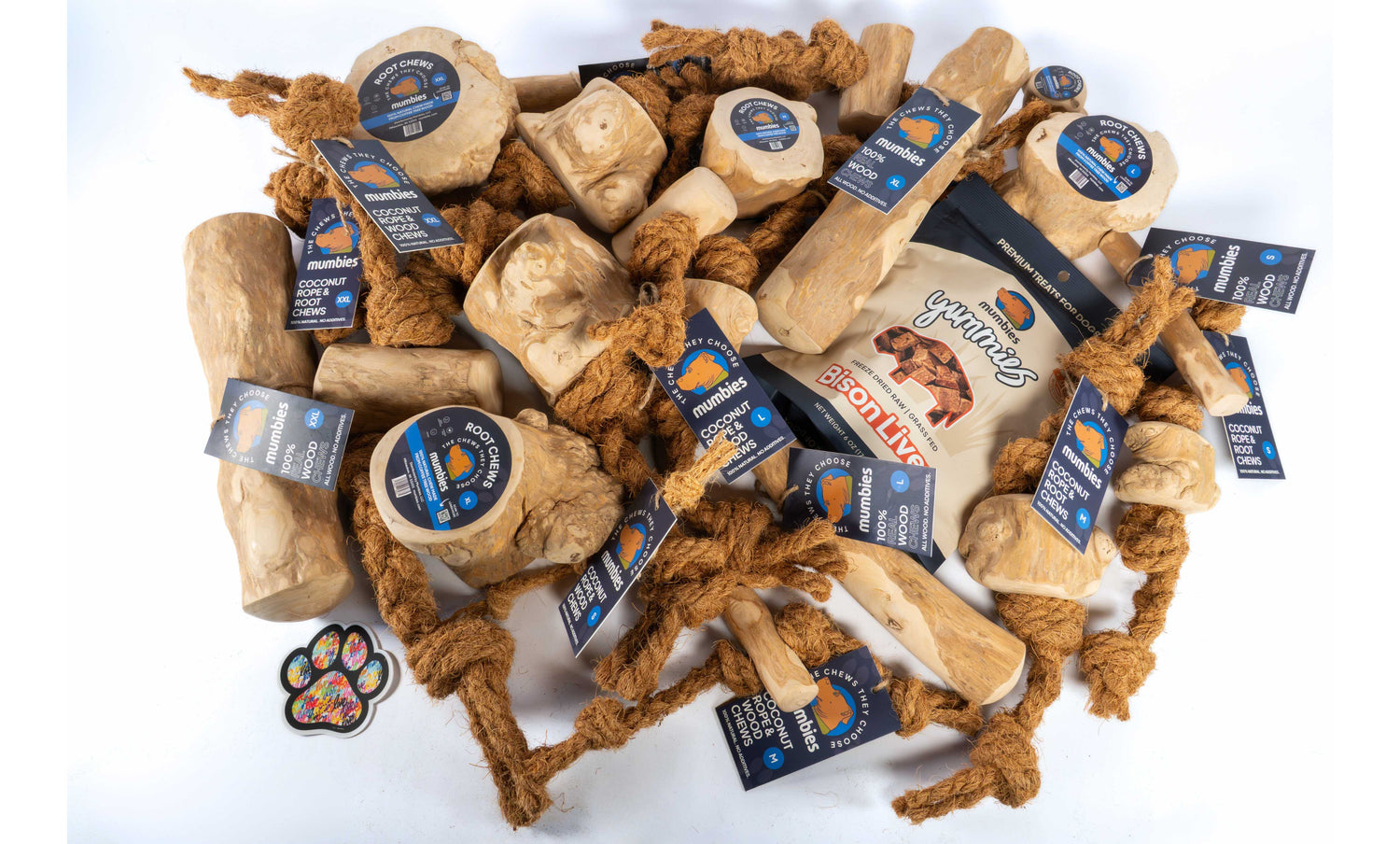
The great news: if your dog loves sticks, they're going to love coffee wood chews. The appeal is almost identical — it's natural wood, it has that satisfying resistance, and it smells like the outside world. The difference is in how the wood behaves.
Mumbies Original Chew
Coffee wood — the kind used in Mumbies Original Chews — comes from the Coffea canephora tree, sourced sustainably as a byproduct of the coffee farming industry. It's an extremely dense, tightly grained wood that doesn't crack or splinter the way backyard sticks do. Instead of fracturing into sharp pieces, it frays. The chewing action pulls apart soft fibers that dogs spit out naturally.
It's 100 percent natural. No additives, no preservatives, no chemicals. Just wood — the good kind.
And for dogs who love the ritual of carrying something around? A Mumbies chew scratches that same itch. We've heard from plenty of dog parents whose pups carry their chew from room to room like a prized possession. 🐶
Mumbies Root Chew
If your dog is an especially dedicated chewer — the kind who could strip a branch in minutes — the Root Chew is worth considering. It comes from the root of the coffee tree, which is the oldest and densest part of the plant. It has a knobby, irregular shape that dogs seem to love working around, and it tends to last noticeably longer for heavy chewers.

Making the switch
If your dog is a committed stick enthusiast, introducing a new chew might take a little patience. A few things that help:
Bring the chew outside. Let your dog encounter it in the same context where they'd usually find a stick — on a walk, in the yard, during outdoor time. The association helps.
Make it interesting. Some dogs take to a new chew immediately. Others need a little encouragement. Rubbing a small amount of peanut butter or a high-value treat on the end of the chew can help introduce it, especially in the first few sessions.
Size up for strong chewers. This matters a lot with coffee wood chews. The smaller sizes come from younger, less dense parts of the tree — a heavy chewer can go through them faster than intended. If your dog loves sticks and really goes for it, start with a larger size than you think you need. Our sizing guide is a helpful starting point.
Redirect calmly on walks. When your dog goes for a stick on a trail, a calm redirect to their chew (or a high-value treat as a trade) works better than a reaction. Over time they'll start to understand what's theirs to chew and what's just part of the scenery.
The bottom line
Sticks are appealing to dogs for all the right reasons. The instinct is good. The stick just doesn't live up to it.
Coffee wood gives your dog everything they're actually looking for — the texture, the resistance, the naturalness, the outdoor-wood satisfaction — without the splintering, the unknown chemicals, or the trip to the vet.

