

Why enrichment matters for dogs — and simple ways to give your pup more of it
Share
A tired dog is a good dog. But there's more than one way to tire a dog out — and the one most people overlook is also the most powerful.
Physical exercise gets a lot of attention. And yes, walks matter. But mental enrichment — giving your dog's brain something to actually do — is just as important for their health, behavior, and overall happiness. Sometimes more so.
Here's why it matters, what it actually looks like, and some easy ways to bring more of it into your dog's everyday life. 🐾
What is dog enrichment, exactly?
Enrichment is anything that engages your dog's natural instincts and gives their brain a job to do. It's the difference between a dog who sits in a quiet house for eight hours and a dog who has had something to sniff, chew, chase, solve, or explore.
Dogs were bred — for thousands of years — to work. To herd, hunt, retrieve, track, and protect. Most modern dogs don't have jobs anymore, but their brains didn't get the memo. That drive is still there. Enrichment is how we channel it.
When a dog doesn't get enough mental stimulation, that energy has to go somewhere. Usually somewhere you'd rather it didn't — like your couch, your shoes, or a very enthusiastic redecorating of the trash can.
The real benefits of enrichment
It reduces boredom and destructive behavior
This is the big one most dog parents feel first. A dog who is mentally stimulated is a dog who isn't looking for ways to entertain themselves. Chewing furniture, excessive barking, counter surfing, digging — these behaviors are almost always a sign of an under-stimulated dog, not a bad one.
It helps with anxiety and stress
Enrichment activities — especially sniffing, chewing, and problem-solving — have a measurable calming effect on dogs. They lower cortisol (the stress hormone) and engage the parts of the brain associated with focus and reward. For anxious dogs, a good enrichment session can be more effective than almost anything else at bringing them back to baseline.
Mental fatigue is real — and it's a good thing
A dog who has spent 20 minutes working through a puzzle feeder or a satisfying chew is often just as tired as a dog who went for a run. The brain burns a lot of energy when it's working. Mental enrichment is one of the most efficient ways to help a high-energy dog settle — especially on days when a long walk just isn't possible.
It builds confidence
Enrichment gives dogs the experience of figuring things out and succeeding. For anxious or timid dogs especially, that repeated experience of "I tried something and it worked" adds up. It builds the kind of quiet confidence that makes dogs more adaptable, calmer in new situations, and generally more settled in themselves.
It deepens your bond
A lot of enrichment activities involve you — and even the ones that don't, you're still the one setting them up. Your dog learns to associate you with good things happening. That trust compounds over time.
Signs your dog might need more enrichment
You don't need a checklist to know — but here are some common signals:
- Destructive chewing or digging
- Excessive barking or whining, especially when you're home
- Restlessness — can't seem to settle even after a walk
- Attention-seeking behaviors that feel relentless
- Getting into things they know they shouldn't (trash, counters, laundry)
- Seemingly bored with toys almost immediately
If any of those sound familiar, more enrichment is almost always part of the answer.
Easy ways to enrich your dog every day
The good news: enrichment doesn't have to be elaborate. Some of the most effective options are also the simplest.
1. Let them sniff — really sniff
A sniff walk is one of the most underrated enrichment tools out there. Instead of keeping a brisk pace, let your dog lead. Let them stop. Let them spend four minutes investigating a single blade of grass if that's what they want to do. A dog's nose processes the world in a way that's almost incomprehensible to us — sniffing is genuinely mentally exhausting for them in the best possible way.
A 20-minute sniff walk can tire a dog out more than a 45-minute power walk. Give it a try.
2. Give them something worthy to chew
Chewing is one of the most natural and effective enrichment activities for dogs. It engages their jaw, focuses their brain, and releases the kind of calm, satisfied energy that makes for a very good afternoon.
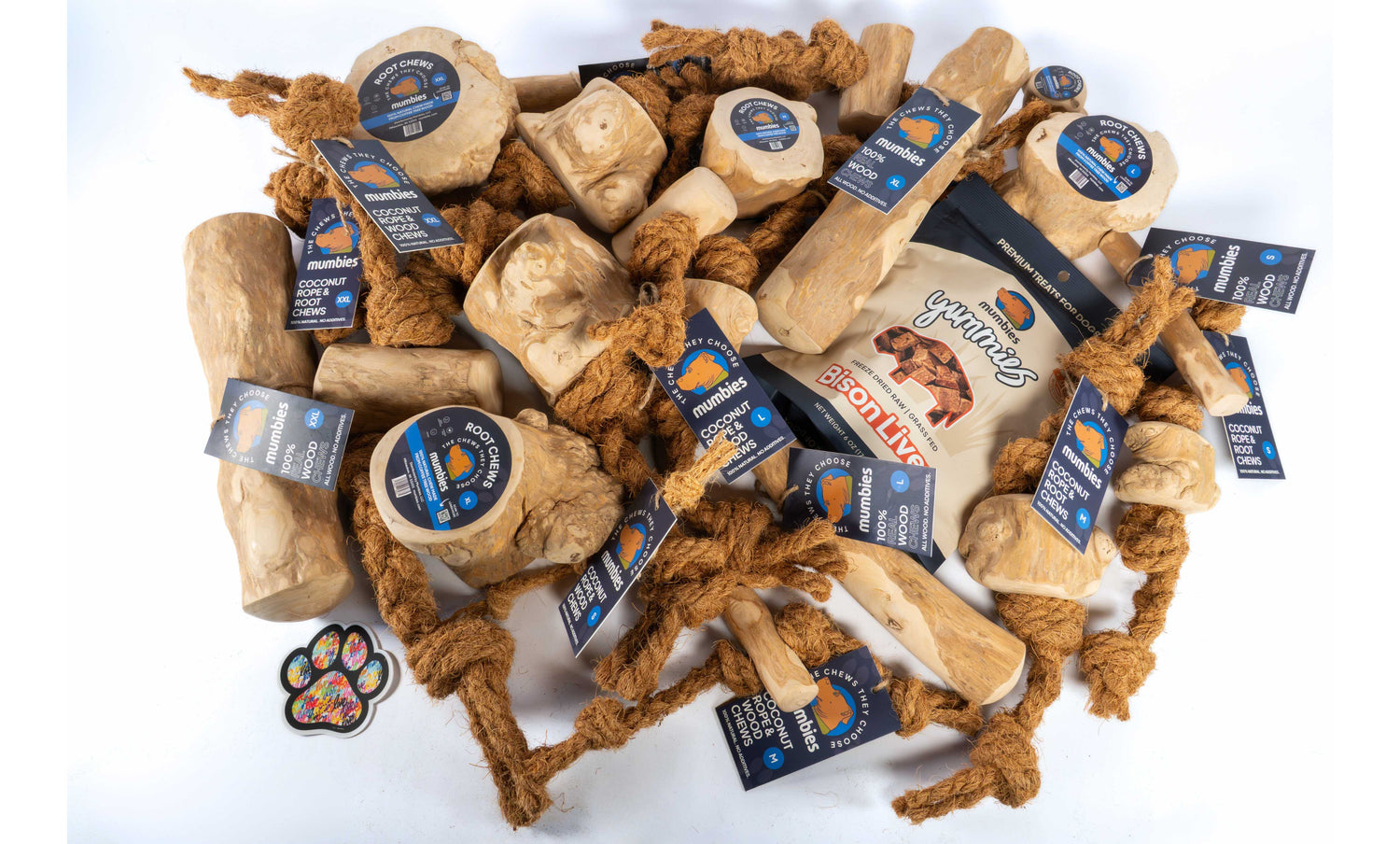
Not all chews are equal here. Something that disappears in five minutes doesn't give the brain much to work with. A Mumbies Original Chew — made from dense, naturally resistant coffee wood — gives dogs something to really work through. The texture, the resistance, the gradual progress of gnawing it down: all of it counts as enrichment. Many dog parents notice their dogs settle significantly after a chew session, which makes sense — their brain has been genuinely working.
For heavy chewers or dogs who want an extra challenge, the Root Chew is worth trying. It comes from the root of the coffee tree — the densest, most mature part — and has a knobby, irregular shape dogs love to work around. It's the long-game chew.
3. Try a puzzle feeder or snuffle mat
Instead of a bowl, make mealtime a little more interesting. Puzzle feeders require dogs to figure out how to access their food — sliding panels, lifting covers, pushing pieces. Snuffle mats hide kibble in fabric folds that dogs root through with their nose.
Either one turns a two-minute meal into a 10- to 15-minute brain workout. For dogs who eat too fast, it's also a practical solution.
4. Use treats to build focus and reward curiosity
High-value treats aren't just for training — they're enrichment tools. Hiding a few pieces of Yummies Bison Liver Treats around the house or yard for your dog to find turns sniffing into a game with a payoff. It engages their nose, builds focus, and gives them the satisfaction of finding something.
Because Yummies are single-ingredient and freeze-dried, they're also easy to crumble into smaller pieces — perfect for scatter feeding, stuffing into a snuffle mat, or using as the prize at the end of a puzzle feeder.
5. Rotate toys regularly
Dogs habituate to toys quickly — something that was exciting last week can become furniture this week. You don't need more toys. You need to rotate them. Put most away and bring out two or three at a time. When you swap them back in after a week or two, they feel new again.
The Mumbies Coconut Rope — whether it's a ball, a tug, or a ring — is great for interactive play, which counts as enrichment too. Tug, fetch, and chase games engage the prey drive and get dogs thinking and reacting. They're softer than a typical toy, more like a plushie than a hard chew, which makes them especially good for interactive sessions where you're both involved.
6. Training — even just five minutes
Training is pure enrichment. It requires a dog to focus, try, fail, adjust, and succeed. Five minutes of working on a new trick or practicing an existing one gives a dog's brain more of a workout than most people expect.
The key is keeping it short, positive, and rewarding. A few pieces of Yummies Bison Liver Treats go a long way here — the intensity of the flavor keeps attention sharp even with distractions.
7. Give them a window
This sounds simple because it is. A dog with a view of the outside world — birds, squirrels, people walking by, the neighbor's cat doing absolutely nothing — has something to observe and process. A window perch, a cleared sill, or even just moving a piece of furniture to give them access can make a real difference for dogs who spend time home alone.
The short version
Enrichment isn't a luxury. It's a core part of what a dog needs to feel good, behave well, and actually thrive — not just survive. And it doesn't have to be complicated. A sniff walk, a good chew, a scatter feed, five minutes of training: small things add up fast.
Your dog's brain wants a job. Give it one. 🐾

