

Why we switched away from plastic dog toys — and what we use instead
If you've ever watched your dog demolish a plastic toy in under 10 minutes, you already know the feeling. A pile of colorful fragments on the floor, a dog looking very pleased with themselves, and you wondering what just happened.
Plastic dog toys are everywhere. They're cheap, they're bright, and they're easy to grab off a shelf. But more and more dog parents are taking a second look at what's actually in those toys — and what happens when a dog inevitably gets through them. Here's what we found when we started asking those questions, and what we landed on instead.
The problem with plastic dog toys
Dogs chew through them — and then what?
Most plastic and synthetic rubber toys aren't designed to withstand serious chewing. They're designed to look appealing on a shelf. When a dog with any real chewing drive gets hold of one, the result is usually chunks — sometimes small ones, sometimes not so small.
Ingested plastic fragments can cause digestive upset, blockages, or in more serious cases, internal injury. It's not a guarantee that something goes wrong, but it's a real risk that's worth knowing about — especially for dogs who are aggressive chewers or who tend to swallow things they probably shouldn't.
What's actually in the plastic?
This is where it gets a little murky. Many conventional plastic and rubber dog toys are made with materials that can include BPA, phthalates, PVC, or chemical dyes — compounds that have known concerns for humans and animals alike. Regulation around pet toy materials is not nearly as rigorous as it is for children's toys, which means a lot of what's on the market hasn't been thoroughly tested for what happens when a dog chews on it repeatedly for weeks or months.
We're not here to be alarmist about it. But "I'm not totally sure what this is made of" is a reasonable thing to want to resolve when it comes to something your dog spends a lot of time with their mouth on.
The environmental piece
Plastic dog toys are almost universally single-use in practice. They break, they get thrown away, and they end up in landfill — where plastic fragments can persist for hundreds of years. For dog parents who are making intentional choices about reducing plastic in other areas of their lives, the toy basket is worth looking at too.
What to look for in a plastic-free alternative
Not all natural toys are created equal — and switching away from plastic doesn't mean settling for something that falls apart in five minutes. Here's what actually matters:
Natural materials you can verify. You want to be able to read the ingredient list and know exactly what you're looking at. Wood, natural fiber, single-source animal products — these are materials with transparent origins.
Designed to break down safely. Natural toys that fray, soften, or wear down gradually — rather than snap, crack, or fragment — are the ones worth looking for.
What we use at Mumbies — and why
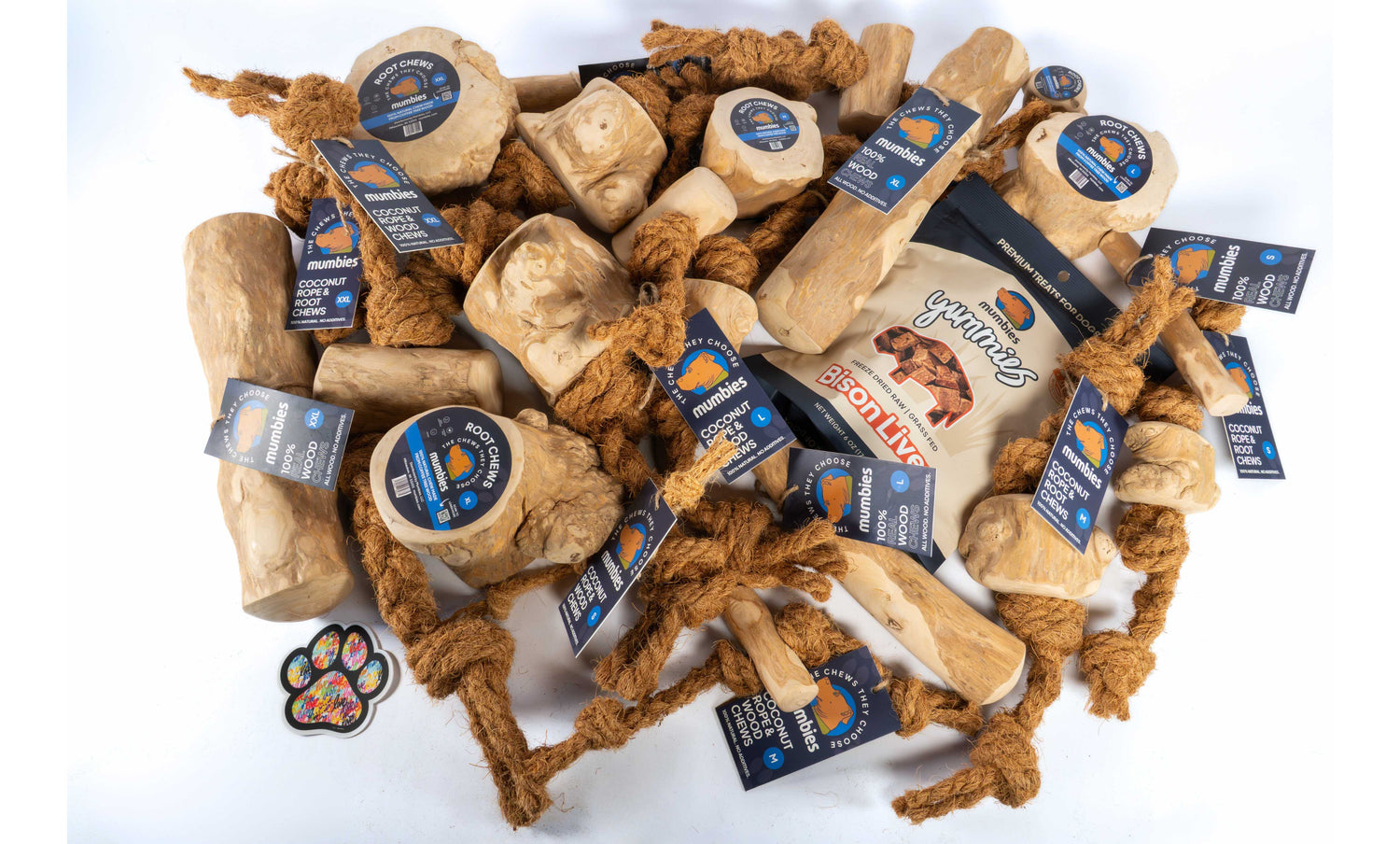
At Mumbies, every product we make starts from the same place: what's actually good for the dog, made from something real. Here's how our lineup fits into a plastic-free toy basket:
For chewers: Original Chew and Root Chew
Coffee wood is one of the most naturally suited materials for dog chewing. The Mumbies Original Chew is made from the wood of the Coffea canephora tree — 100 percent natural, no treatments, no additives. It's dense enough to satisfy serious chewers, and instead of cracking or splintering the way plastic or brittle wood does, it frays into soft fibers that dogs spit out naturally.
The Root Chew takes it a step further. Made from the root of the coffee tree — the oldest, densest part — it's the go-to for dogs who want something they can really work through. The knobby, irregular shape gives them something interesting to navigate, and it tends to last noticeably longer than the trunk-based chews.
Both are 100 percent coffee wood. Nothing else.
For play: the Coconut Rope
The Mumbies Coconut Rope — available as a ball, a tug, and a ring — is made from natural coconut fiber. It's soft and textured, more like a plushie than a hard toy, and it's great for interactive play: tug sessions, fetch, or just something to carry around the house with an air of importance.
Coconut fiber is completely natural and biodegradable. When it eventually reaches the end of its life, it breaks down the way natural materials do — not the way a chunk of plastic does.
It's worth saying: the Coconut Rope is a play toy, not a chew toy. If your dog is a dedicated chewer, pair it with a chew rather than expecting it to hold up to serious gnawing on its own. But for interactive play and the dogs who love to toss something around? It's a great fit.

Making the switch gradually
You don't have to overhaul everything at once. A few practical starting points:
Start with the chew. If your dog chews through plastic toys, that's the most immediate thing to address. Swapping in a coffee wood chew gives them something genuinely satisfying — and removes the plastic fragment concern entirely.
Add natural play toys as things wear out. Rather than throwing out what you have, let things run their course and replace them with natural alternatives as they go. It's a slower transition, but it's more practical and less wasteful.
Check labels when you buy new. Look for toys that list their materials clearly. If a toy doesn't tell you what it's made of, that's worth paying attention to.
Size appropriately. This matters as much with natural toys as with anything else. A chew that's sized right for your dog's weight and chewing style will last longer and be safer than one that isn't. Our sizing guide is a good place to start if you're not sure where to land.
The short version
Plastic dog toys are convenient, but they come with real questions — about safety, about materials, and about what happens when your dog inevitably chews through them. Switching to natural alternatives doesn't mean compromising on fun or function. It means knowing exactly what your dog is spending time with their mouth on, and feeling good about the answer.
Coffee wood for chewing. Coconut fiber for play. Real materials, real transparency, nothing you have to wonder about.

